
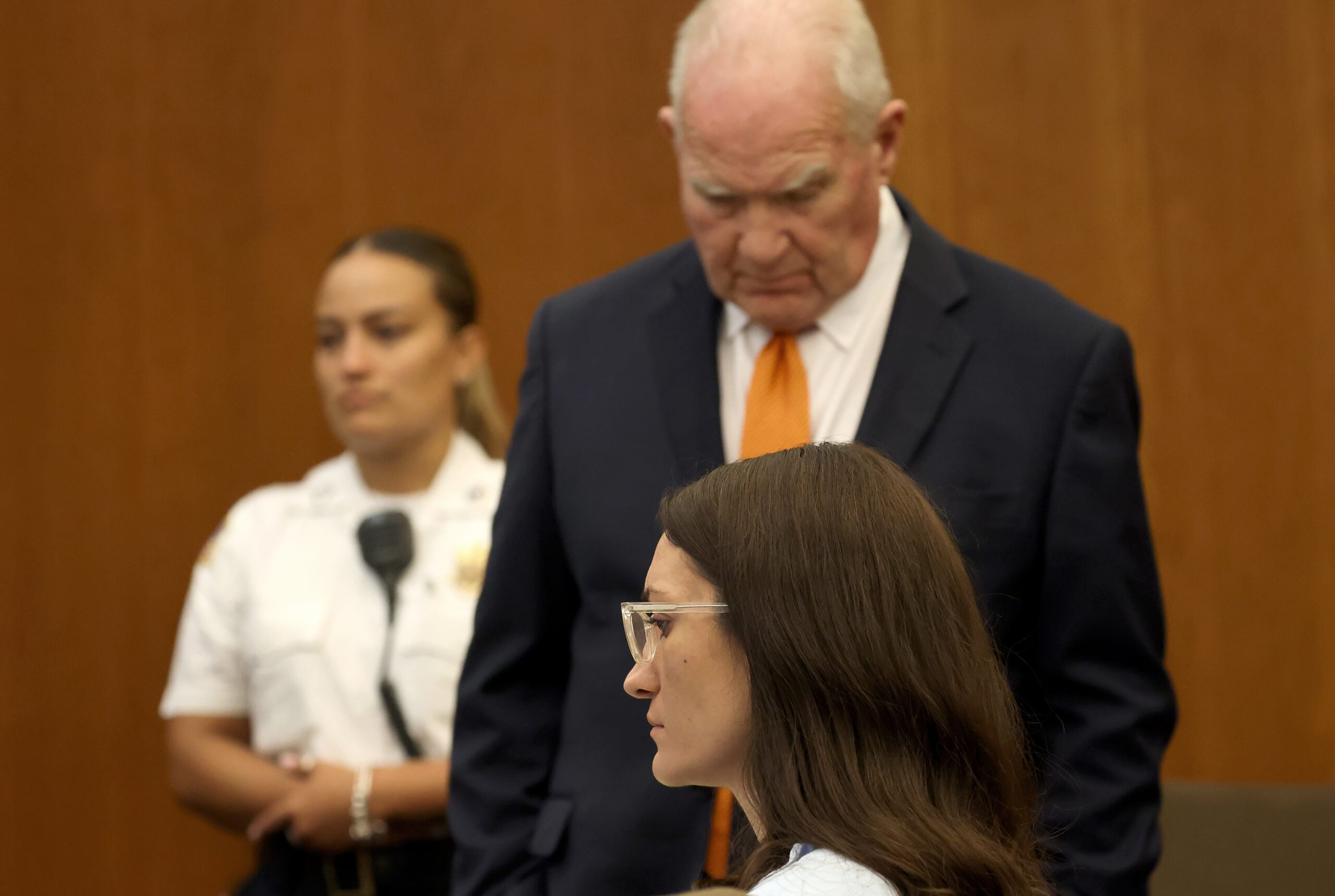
The trial of Lindsay Clancy, the Duxbury mother charged in the January 2023 killings of her three young children, continued Thursday.
Clancy is charged with three counts of first-degree murder in the deaths of Cora, 5; Dawson, 3; and Callan, 8 months. Prosecutors say she deliberately planned the killings, but Clancy contends she was suffering from severe postpartum mental illness and is not criminally responsible for the killings.
Dr. Kimberly Springer
As expected, the prosecution’s first witness was Dr. Kimberly Springer, the Massachusetts medical examiner who performed an autopsy on Clancy’s youngest child, 8-month-old Callan, in January 2023.
Prosecutor Jennifer Sprague showed Springer several photos of the boy, which were also displayed for jurors. The images were not published on the screens that the courtroom audience can see and did not appear to be shown on the screen in front of Clancy at the defense table.
Clancy audibly sobbed as Springer described the baby’s injuries. It was brutal testimony; Springer offered detailed descriptions of how the boy died.
The emotional weight of the testimony seemed to impact jurors, too. One woman in the front row appeared to dab away tears.
After Springer’s testimony concluded, Judge William F. Sullivan sent jurors out for a break. Clancy continued to sob loudly as she was wheeled out of the courtroom.
Dr. Lindsay Rosshirt
The next witness to testify was Dr. Lindsay Rosshirt, who was the pediatrician for all three Clancy children from 2019 to 2023.
Sprague began by asking Rosshirt about Callan, asking whether she had noticed any issues with the baby. The prosecutor invoked language Clancy used in a diary entry read to jurors earlier in the week, in which she said the boy was not meeting his milestones. Rosshirt said she never noticed anything out of the ordinary.
Rosshirt said she was familiar with signs of postpartum mental health issues, and would refer mothers exhibiting symptoms to treatment. She never did so for Clancy, she said.
On Jan. 24, 2023, the day of the killings, Rosshirt conducted Cora’s annual check-up. It was a “very normal visit,” she said, and she saw no issues with Clancy.
On cross-examination, defense attorney Kevin Reddington posed questions designed to highlight Clancy’s postpartum struggles, asking Rosshirt if she was aware Clancy began seeing a psychiatrist in October 2022, if she knew Clancy called a suicide hotline and if she knew Clancy self-admitted to a psychiatric hospital in December 2022.
Rosshirt said she wasn’t aware, and agreed with Reddington that Clancy “wasn’t a complainer.”
“She was a hell of a mother, wasn’t she?” he asked. “I always thought she was a good mom,” Rosshirt replied.
After Rosshirt, prosecutors called multiple women who taught the Clancy children at the Learning Sprouts pre-school in Duxbury.
Susan Fraone
Susan Fraone taught Dawson, and recalled he began having hard drop-offs in mid-October 2022, which was unusual for him. Fraone was asked about a conversation she had with Clancy around Thanksgiving in 2022.
“When you had that conversation with Lindsay Clancy sometime in November of 2022, did she ever say anything about insomnia or not feeling well or being depressed or anything like that?” Prosecutor Shanan Buckingham asked.
Fraone said she didn’t.
Susan Bertolo
Jurors then heard from Susan Bertolo, who taught Cora.
Bertolo recalled the girl used the bathroom several times on Jan. 23, 2023, which she reported to Clancy. Clancy told her the girl had a doctor’s appointment the next day.
When they spoke, Bertolo said, she didn’t notice anything different about Clancy.
Bertolo also recalled Cora telling her in December 2022 or January 2023 that her mom was in the hospital and she missed her mom.
Stephanie Williams
Stephanie Williams said she taught Cora at the preschool from September 2022 to January 2023.
On Jan. 23, 2023, Williams recalled learning from other teachers that Cora wasn’t feeling well. Cora said her stomach hurt, Williams recalled.
Clancy picked Cora up that day. Williams recalled Clancy entering the classroom and picking up the girl, telling her, “Oh baby, let’s go get Dawson, and let’s go home.”
Williams told Buckingham she didn’t notice anything unusual about Clancy that day. She was a “very loving mother who cared about her children,” Williams said.
Andrea Hennigan
The next witness to testify was Andrea Hennigan, a labor and delivery nurse at Massachusetts General Hospital who worked with Clancy beginning in 2015.
While Hennigan said she had no training regarding postpartum depression, she said nurses at the hospital would screen new mothers if they returned after having their children.
Hennigan recalled speaking to Clancy twice after Clancy gave birth to Callan in 2022, once in June and once in November.
In June, Clancy’s demeanor appeared “very good,” and she was her “typical self,” Hennigan said. In November, they met for lunch at a restaurant in Hingham, where Clancy told her she felt she wasn’t ready to return to work because she was struggling to sleep and not feeling herself. Hennigan recalled Clancy using the term “brain fog.”
Hennigan said she and two other nurses friendly with Clancy all encouraged her to get the help and support she needed. Hennigan added she was not concerned about Clancy harming herself or harming the children.
They communicated over text around Thanksgiving, and she recalled Clancy telling her she had been referred to a program at South Shore Hospital focused on postpartum mental health issues.
Then, around New Year’s, Clancy told Hennigan and the other nurses she couldn’t get together with them because she was involved in an intensive mental health treatment program.
On Jan. 23, 2023 — the day before the killings — Hennigan said Clancy told her she was continuing to try and find the right medication to address her symptoms.
Sprague asked if the texts were “more positive and hopeful” than other messages. Hennigan said she believed Clancy was “always hopeful she would get the care she was seeking.”
On cross-examination, Hennigan told Reddington Clancy was “not a complainer about work or home or anything.”
“We were friends, and she did share more personal details with me,” she said.
Hennigan said she observed Clancy to be a “very loving, caring mother.”
“This is exactly what she wanted,” Henigan said. “She wanted a big family. She was happy to have her children close in age.”
When Reddington asked if Clancy ever complained about “leaving behind the life she had” — something prosecutors have suggested she felt — Hennigan seemed surprised.
“Oh no,” she said. “Lindsay, from the time I met her as a young woman, very much desired to be a mother and have a family.”
Bethany Decollibus
The final witness to testify before the scheduled morning recess Thursday was Bethany Decollibus, a marriage and family therapist who was friendly with Clancy.
Decollibus said she saw Clancy and her children on essentially a weekly basis for music classes or scheduled playdates. She recalled Clancy as “active, engaged, friendly.”
While Decollibus said she didn’t notice any changes in Clancy’s behavior, she did notice that she began “appearing more tired” after Callan was born.
Clancy also told Decollibus she was having trouble sleeping.
“It was an ongoing struggle” for Clancy, Decollibus said. “For a period of time it felt normal, but after it seemed to continue and not let up for her, I definitely worried about her and was concerned.”
Clancy had no trouble interacting with people or doing typical activities, Decollibus said. She never reported having suicidal thoughts or having thoughts of harming others.
During a dinner with another friend in November 2022, Decollibus said Clancy continued to report issues.
“I remember her expressing feeling hopeful about the possibility that things could start to get better,” she said.
At Cora’s birthday party in January, Clancy reported “feeling like a zombie,” Decollibus said.
“Was there anything about her appearance or the way she was interacting or behaving that, when you saw her, you thought she looked like a zombie?” Sprague asked. “There’s a difference between being tired and looking like a zombie, right?”
Decollibus agreed Clancy “didn’t look like a zombie.”
On cross-examination, Reddington prompted Decollibus about her observations of Clancy as a mother.
“She loved her kids. She was warm, kind,” she said.
Amy Bevins
After the break, prosecutors called Amy Bevins, a licensed behavioral therapist and a childhood friend of Clancy’s.
Bevins said she and Clancy had been friends for 29 years and talked regularly as they got older and went to college.
Sprague asked Bevins if Clancy ever told her she was taking mental health medications or struggling with anxiety in nursing school. Bevins said she didn’t.
It’s at least the second time during the course of the trial prosecutors have raised the specter of Clancy having mental health issues well before the birth of her children, but no witnesses have confirmed knowing about the issues.
Bevins said she didn’t notice any changes in Clancy’s behavior after the birth of any of Clancy’s three children.
In November 2022, Clancy visited her parents in Connecticut. Bevins said she and Clancy went out to breakfast with other friends. She saw no cause for concern then, she said.
Bevins recounted a text conversation she had with Clancy in January 2022 just days before the killing in which Clancy told her medication she was taking had been causing her to have “dark thoughts.” The conversation seemed hopeful, she said.
After the killings, in March 2023, Bevins visited Clancy at Spaulding Rehabilitation Hospital, at the request of some of Clancy’s family.
“It was a pretty basic visit,” Bevins said.
Clancy never discussed the killings and did not mention her children while they were together, Bevins said. Clancy appeared to have a “neutral” affect.
Reddington seemed to try to disarm Bevins at the start of his cross-examination, telling her, “You’re nervous. Don’t be.”
Bevins said she knew Clancy to be “a good person, a good friend, a good mom.”
She told Reddington that Clancy’s sister told her not to bring up the killings during the visit at Spaulding.
It would have been an “awkward, uncomfortable topic?” Reddington suggested. “It would be for anybody,” Bevins replied.
Bevins said she believed Clancy’s mental health providers may have recommended to family that she not bring up the killings.
Reddington asked Bevins several questions about a text conversation she had with Clancy where the two of them discussed medication. For the most part, Bevins couldn’t recall details, but said Clancy asked her about Lexapro. Bevins agreed with Reddington that Clancy “told you about some of the medications that she was taking, and that there were some difficulties with it.”
During the January 2023 conversation, Clancy never explained what she meant by “dark thoughts,” Bevins said.
Christopher Clancy
The next witness to testify Thursday afternoon was Christopher Clancy, Lindsay Clancy’s former father-in-law.
Lindsay Clancy was “very mothering” and “protective … like any mother would be” after Callan was born, Christopher Clancy said. He recalled similar behavior when the other children were younger, but again couched it, saying “I think like any other mother though.”
He then recalled Lindsay Clancy and the family visiting in November 2022.
That day, Lindsay Clancy appeared, “very good,” he said. Later that month, at Lindsay Clancy’s sister-in-law’s house, she seemed “quiet,” Christopher Clancy said.
He later recalled she was “staring off into the distance,” and seemed distracted and nervous.
When trying to get the kids settled for Thanksgiving dinner, Lindsay Clancy got frustrated with Dawson, who was “being a little silly,” Christopher Clancy said.
She “took him by the arm to get him seated,” he recalled. “It wasn’t anything crazy.”
Dawson was “a handful,” he recalled, adding “he was a good boy.”
Prosecutors have suggested in court papers that Lindsay Clancy may have disliked Dawson, noting that at one point she complained about his behavior on an online forum. They have also claimed she killed Dawson first, and that he struggled more than the other two children as he was strangled.
Christopher Clancy also recalled visits with the family on Christmas Eve and Christmas Day. On Christmas Eve, he said, Lindsay Clancy’s demeanor was “ok,” adding, “it wasn’t terrible.” She seemed in good spirits, he said.
On Christmas Day, Lindsay Clancy seemed very happy, he said.
As he has with almost every witness who testified about their interactions with Lindsay Clancy and her children, Reddington asked Christopher Clancy to describe what she was like as a mother.
“She was very, very good. She fed them great. She did a lot of things with them,” he said, adding they seemed “like the All-American family.”
He also followed up on Christopher Clancy’s knowledge of his daughter-in-law’s mental health challenges.
“I knew she was having a hard time sleeping. I knew she just didn’t feel well,” Christopher Clancy said.
Christopher Clancy said he and his wife were asked to go to dinner with their son, daughter-in-law and grandchildren on the night of the killings, but couldn’t because they had other plans.
After his testimony concluded, Sullivan sent jurors out for lunch.
Kyle Carney
After the lunch break, prosecutors called Kyle Carney, a longtime friend of Lindsay Clancy’s ex-husband, Patrick.
Carney recounted a small get-together he held with the Clancy family on Jan. 22, 2023. Clancy appeared “quieter than normal” that day, he said.
As Sprague pushed him on that recollection, he said her behavior and demeanor “appeared normal.”
It was a “normal great day?” Sprague asked, citing Carney’s previous description. He agreed it was.
Reddington did not cross-examine him.
Sgt. Andrew Chiachio
The final witness of the day was Massachusetts State Police Sgt. Andrew Chiachio.
Chiachio testified that he went to the Plymouth restaurant and Kingston CVS that Clancy’s ex-husband visited on the night of the killings, and collected surveillance from both locations. He told jurors he calculated how long it would take to get to each location from the Clancys’ home in Duxbury.
He also performed interviews with certain witnesses, obtained a search warrant for blood samples on the side of the home and collected Clancy’s DNA in May 2024.
Chiachio also got a search warrant for Clancy’s social media posts on Facebook. During that search, investigators found a post from May 2021 in a group titled “Attachment Parenting for Littles,” in which she said she sought advice for difficulty with Dawson, her middle child.
Buckingham then read the entire post for the jury. In it, Clancy said she was “finding (Dawson) to be the most difficult human I’ve encountered,” and that he was “always fighting me and crying about doing … very normal things.”
Prosecutors appear to be using the post, and Christopher Clancy’s testimony about his behavior, to suggest to the jury that Lindsay Clancy harbored some animosity for the boy.
On a brief cross-examination, Reddington proposed to Chiachio that investigators “must have turned things inside out to find if Lindsay Clancy was abusive to her son, Dawson.”
“You found nothing, did you?” he asked. Chiachio said they did not.
—
Charlie McKenna; masslive.com; (TNS) || ©2026 Advance Local Media LLC. Visit masslive.com. Distributed by Tribune Content Agency, LLC.