
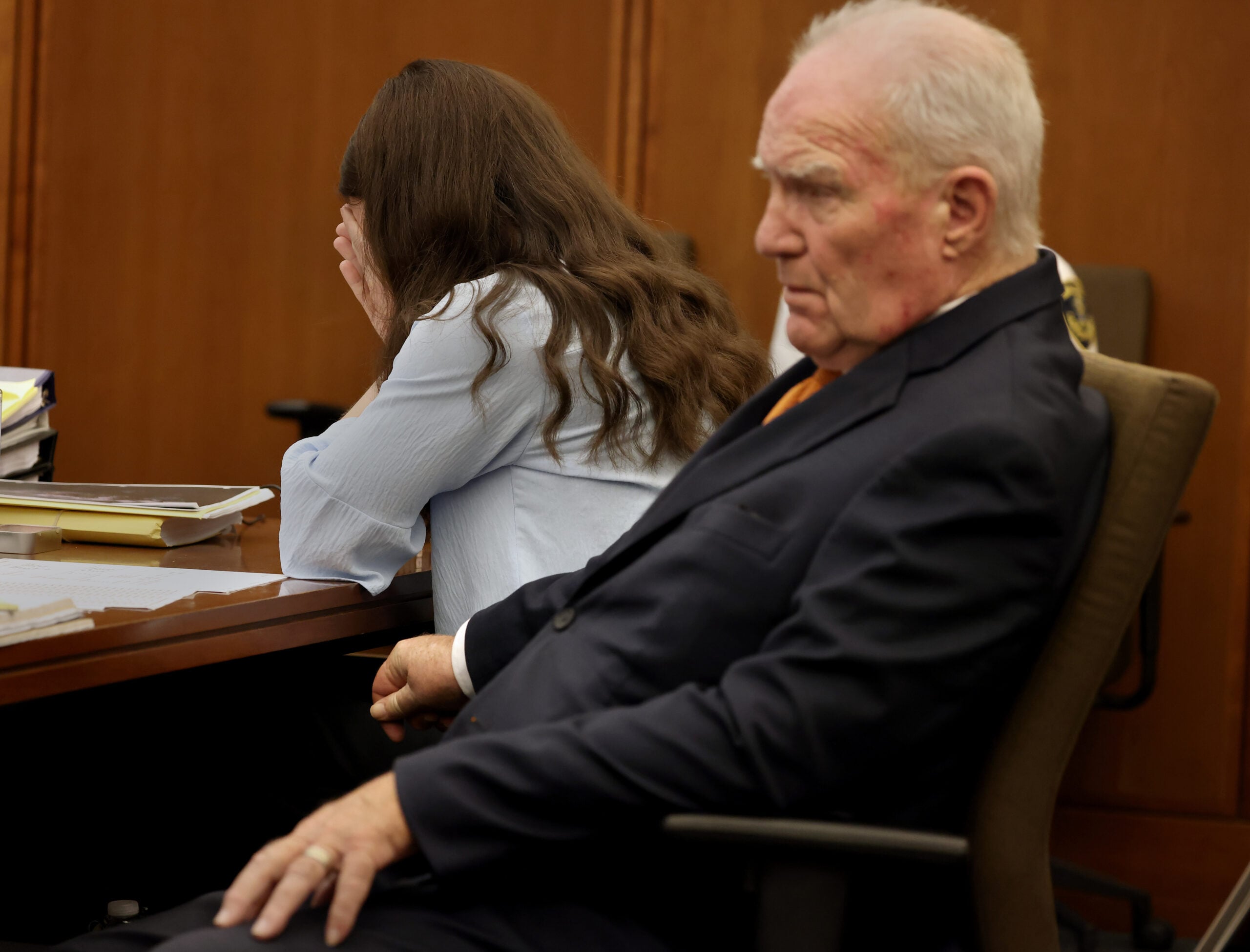
The murder trial of Lindsay Clancy, who is accused of strangling her three children in the basement of her Massachusetts home in 2023, entered its sixth day of testimony Tuesday with her speaking for the first time in court while agreeing to stipulate” to the facts surrounding the autopsies of Cora, 5, Dawson, 3, and Callan, 8 months old.
Lindsay Clancy told Judge William Sullivan in a steady voice that she had agreed to stipulate to some of the facts of the case, meaning prosecutors won’t have to prove those facts.
“Yes, your honor,” she said several times as the judge asked his questions. She agreed that she had gone over the stipulation with her attorney, Kevin Reddington, and said, “no,” she didn’t need more time to discuss it with him.
Reddington has not disputed Clancy committed the killings, but has maintained she was in the throes of postpartum psychosis and heard a voice directing her to kill the children. Clancy has bipolar disorder, her lawyer said, and he has argued she improperly was given medications that contributed to her deteriorating mental state.
Prosecutors have argued Clancy is responsible for the killings of the three children, portraying her as controlling and manipulative.
Clancy attempted to take her own life after the killings, including by jumping out of the second-floor of her home in Duxbury. She survived, but was left paralyzed and has appeared in court in a wheelchair.
The facts to which Clancy stipulated were not made public during her initial exchange with the judge. Sullivan later told the jury the stipulated facts were related to the post mortem testing of her children’s bodies, including toxicology on blood and urine, how the samples were tested, and that they were tested properly.
Sullivan made clear earlier that the stipulations could support the prosecution’s position on those facts. “You are basically relieving the Commonwealth of having to prove those facts,” Sullivan said.
“You have the right to confront the witnesses to these facts,” Sullivan said, but Clancy was giving up that right by stipulating to those facts.
“Are you doing this willingly and voluntarily,” Sullivan asked.
“Yes, I am,” Clancy said.
Sullivan found Clancy knowingly entered into the stipulation and accepted the proposed stipulation of facts.
By stipulating some of the facts, it alleviates prosecutors from bringing in dozens of witnesses in terms of the chain of custody for blood, fluids and DNA, Reddington said.
Much of the testimony presented Tuesday morning was focused on the nuts and bolts of evidence gathering and forensic science testing.
Massachusetts State Police Trooper Jonathan O’Loughlin testified that there were no usable fingerprints on a knife taken from the Clancy home and the three exercise bands that had been wrapped around the children’s necks that could identify who last had their hands on the objects.
Two members of the Massachusetts State Police crime lab toxicology unit said on the stand that there were no illegal drugs, such as cocaine, fentanyl, opiates or methamphetamines, in Clancy’s blood.
There also was no alcohol in her system, according to Hilary Griffiths, who works in the toxicology unit. But Clancy did have benzodiazapines in her blood, which are used to treat anxiety and insomnia, Griffiths said.
There is no way to tell how many different benzodiazapine drugs were in her system since some drugs break down in a person’s system differently, Griffiths and Lisa Yelle, who also worked in the toxicology unit, said.
No drugs were found in the blood or urine of Lindsay Clancy’s three children, according to Alicia Zimmermann with the Massachusetts State Police crime lab toxicology unit. The samples that were tested were taken from the children while they were in the hospital and during their autopsies, Zimmermann said.
The last witness for Tuesday was Sherri Crook, a supervisor with the Massachusetts State Police Crime Response Unit who is an expert in blood spatter. As part of her testimony, several photos of blood stains in the Clancy bedroom were shown to the jury, some of which were in a cluster on the floor; others were on a mirror and a nightstand where a bloody knife had been placed.
There was no testimony on how the blood got in the room. But previous witnesses said Lindsay Clancy had slit her wrists and neck, and then jumped out of the window in a suicide attempt. There were a few blood stains on the shingles outside of the house, testimony revealed.
Reddington ended his cross-examination of Crook by asking if someone with blood on their body had hung out the window and then dropped to the ground would it be more likely if blood would have been found all the way down the house. Crook said yes, if the person had struck the house all the way down.
Prosecutors have tried to minimize the wounds on Lindsay Clancy’s neck and wrists, saying it wasn’t a serious suicide attempt. But Reddington repeatedly has asked healthcare providers about the lacerations and his client’s condition when she was found on the ground and taken to area hospitals for treatment.
Clancy’s now-former husband, Patrick Clancy, was the first witness called by the prosecution at the start of the trial last week.
As the trial entered its second week of testimony Monday, prosecutors and the defense each highlighted entries Lindsay Clancy had made in her journals prior to the killings.
“My mind never shuts off,” Clancy wrote in one entry read aloud in court Monday by Reddington.
Entries highlighted by the prosecution included one in which Clancy wrote that she felt “guilty” that baby Callan “isn’t hitting his milestones,” and how she felt “completely overwhelmed” trying to take care of three children.
“It’s like I’m so desperate to get a mental break from taking care of everybody” that her mind was “trying to make up something wrong with me,” said one of the entries.
Psychiatrist testifies about Clancy’s medication
Monday also saw testimony from a number of healthcare professionals who tended to Lindsay Clancy and tried to resuscitate her children.
Dr. Sejal Shah, a psychiatrist with Brigham and Women’s Hospital, was questioned extensively by Reddington on cross-examination about the medications Clancy had been prescribed.
He asked whether Shah was aware that Zoloft and Prozac, drugs that belong to a family of antidepressants known as selective serotonin reuptake inhibitors, or SSRIs, should not be given to a person with bipolar disorder.
“It can be prescribed, oftentimes it’s prescribed with another medication that can be protective,” Shah said.
Reddington rattled off a list of medications and asked Shah whether she was aware Lindsay Clancy was prescribed each, including Valium, Vanspar, Wellbutrin, Hydroxyzine, Klonopin, Lamotrigine, Prozac, Remeron, Quetiapine, Amitriptyline and Ambien.
Given the opportunity to question Shah again, the prosecution noted Clancy was not on all of the medications at once, and that she had not taken all of the pills she was prescribed.
Doctors testify about Clancy’s, Callan’s treatment
Dr. David Casavant with Boston Children’s Hospital said during testimony Monday that 8-month-old Callan was determined to be brain dead three days after he was strangled. After two days of testing, the results showed no significant brain activity and Patrick Clancy decided to remove the baby from life support. He was declared dead on Jan. 27, 2023, according to Casavant.
One emergency room doctor who testified Monday said Lindsay Clancy had hypothermia when she was brought to the hospital, according to WCVB, a Hearst TV station in Boston.
Reddington has suggested that since Lindsay Clancy was on the ground outside for a period of time, her blood flow was slowed by the cold, making the cuts on her wrist and neck stop bleeding. Her temperature was 82.1 when she was in South Shore’s ER, prosecutors said, according to WCVB.
But Dr. Kelly McDonough said she could not remember the extent of Lindsay Clancy’s spinal injury and that the team intubated her to protect her airway. McDonough also called the lacerations to her wrists and neck “superficial, the TV station said.
—
Lisa Backus; The News-Times, Danbury, Conn.; (TNS) || © 2026 The News-Times (Danbury, Conn.). Visit www.newstimes.com. Distributed by Tribune Content Agency, LLC.