
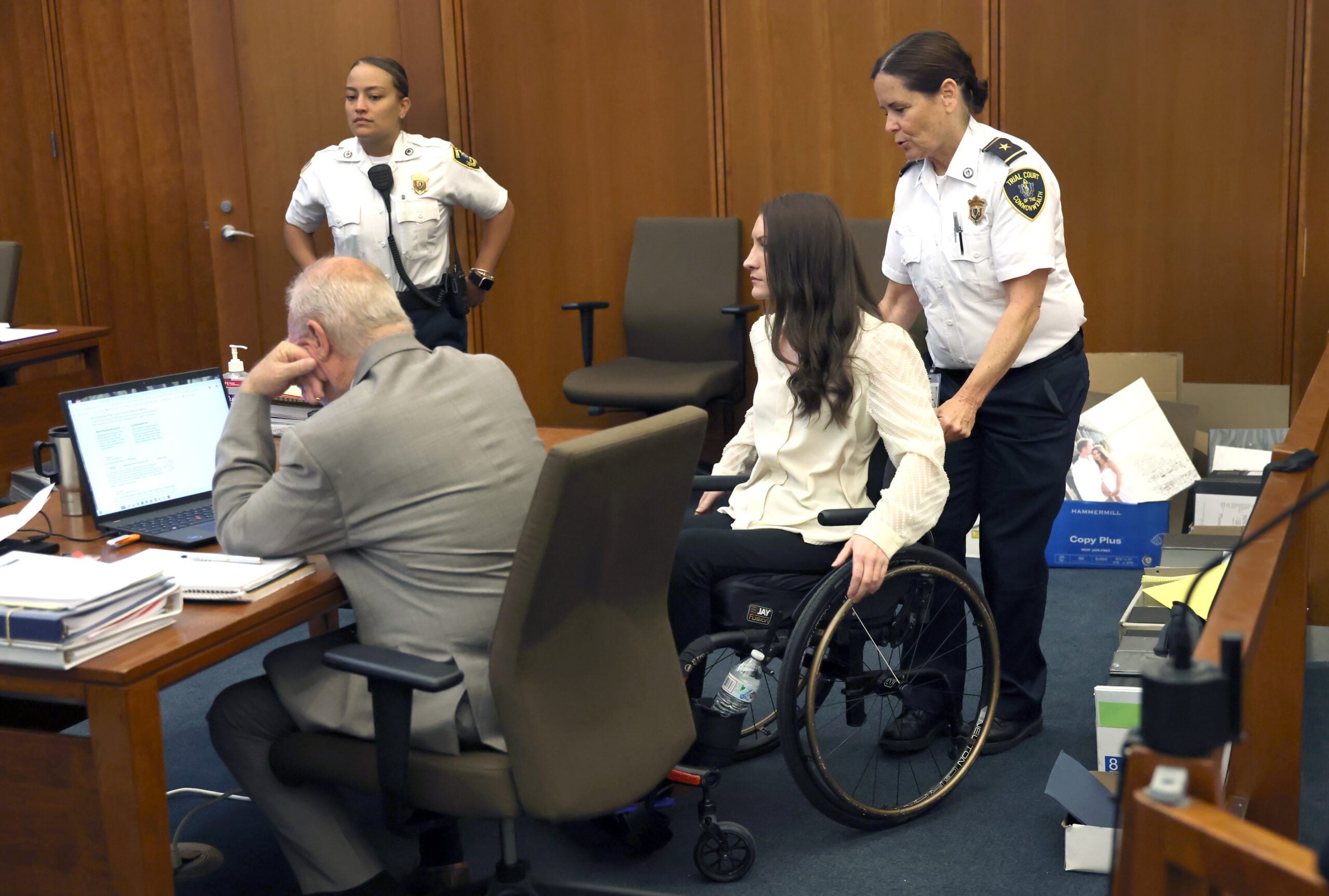
The trial of Lindsay Clancy, a Massachusetts mother accused of murdering her three children in 2023, entered its seventh day of testimony Wednesday, including that from a family nanny who said Clancy “was a wonderful mother.”
Clancy is accused of strangling 3-year-old Dawson, 5-year-old Cora and 8-month-old Callan in the basement of the family’s Duxbury home while her then-husband, Patrick Clancy, was picking up medication and takeout food.
Elaine Rossi, who worked for the Clancys from September to early December 2022, testified she knew Lindsay Clancy was suffering from postpartum depression and on medication, but said under questioning by a prosecutor that she had no concerns about the children and their care with their mother.
When asked whether she had any concerns about Clancy taking care of her children, Rossi said, “none at all, she was a wonderful mother.”
Clancy bowed her head as Rossi described her three children. Cora loved baby dolls and arts and crafts, Dawson was rambunctious and full of energy and Callan “was the happiest baby, he was just a love,” Rossi said.
ALSO READ: Lindsay Clancy Speaks For First Time In Murder Trial Over Deaths Of Her Three Children
Rossi said on the stand she told state police two months after the killings that, “I observed she was a wonderful mom, who loved her kids. She was very concerned with their safety. She was very concerned with Callan’s eating and sleeping, she was a wonderful mother.”
Rossi said under cross-examination that she didn’t find it overbearing that Lindsay Clancy left messages asking her to cut up the children’s food. “Not at all,” Rossi said before adding that she felt it was appropriate, and that her employment with the family ended on a positive note.
“I did love Lindsay, yes,” Rossi said.
She also said that Clancy was losing a significant amount of weight. “I commented to her about that,” Rossi said.
Clancy responded to most of her texts and was appreciative of her work, Rossi said, “very much so.”
“In fact, she was pretty vocal about that, she thought the world of you, right?” Clancy’s attorney Kevin Reddington said.
“Yes,” Rossi said.
On Tuesday, Judge William Sullivan noted before testimony began in Plymouth Superior Court that Clancy had agreed through her lawyer to “stipulate” certain facts — essentially that she agreed certain things happened in regards to the testing of her children after they died.
Sullivan read off a series of questions to Clancy, including that she acknowledged that by agreeing to the stipulation of facts, the prosecution would not have to prove them.
Speaking softly, Clancy indicated she understood Sullivan’s questions, by repeatedly saying, “yes, your honor.”
Clancy, a Connecticut native who grew up in Wallingford, was left paralyzed following an attempt to take her own life after the killings.
Reddington, has not disputed his client committed the killings, but has maintained she was in the throes of postpartum psychosis and heard a voice directing her to kill the children. Clancy has bipolar disorder, her lawyer said, and has argued she improperly was given medications that contributed to her deteriorating mental state.
The prosecution has argued Clancy is criminally responsible for the killings, portraying her as controlling and manipulative.
Before Rossi took the stand, more forensic scientists discussed blood and DNA evidence, saying that there were four drugs used to treat depression and psychosis in her system after the killings and her suicide attempt. None of the drugs were in an amount that would have been lethal, according to a forensic scientist with a Pennsylvania lab were her blood samples had been sent.
Dr. Justin Brower with NMS Laboratories said on the stand that he wasn’t told of the circumstances of the case when the blood was submitted by Massachusetts authorities and that the combination of drugs in her blood could depress the central nervous system, causing someone to stop breathing.
Sullivan also read another stipulation Wednesday, with both sides agreeing to DNA evidence that was found on one of the exercise bands that had been used to strangle the children.
Other evidence presented showed that Patrick Clancy’s DNA was on some of the three bands that were wrapped around the children’s necks as was Lindsay’s, Cora’s Dawson’s and Callan’s.
Earlier, a physician assistant said he applied three stitches to her left wrist to close a three-and-a-half centimeter gash on her right wrist and one stitch to close a two-centimeter cut on her left wrist.
On Tuesday, jurors heard testimony from crime lab scientists, investigators with the Massachusetts State Police and a trauma doctor who treated Lindsay Clancy.
Hilary Griffiths, forensic scientist with the state police crime lab toxicology unit, testified that Clancy’s blood contained no illegal drugs, such as cocaine, fentanyl, methamphetamines or opiates. Clancy’s blood did test positive for benodiazapines, Griffiths said, which are used to treat anxiety, insomnia and seizures.
There was no alcohol in Clancy’s blood, Griffiths said.
The testing did not reveal Lindsay Clancy had used several different drugs, but that there could have breakdown from one drug or a few in her system, Griffiths and Lisa Yelle, who also worked in the Massachusetts State Police crime lab toxicology unit, said.
The prosecution’s first witness was Cristina Carpio, a trauma doctor with South Shore Hospital who treated Clancy. Carpio that the wounds on Lindsay Clancy’s neck and wrist were “superficial” and not their primary concerns when she was brought in after her suicide attempt.
—
Peter Yankowski, Lisa Backus; The Hour, Norwalk, Conn.; (TNS) || 2026 The Hour (Norwalk, Conn.). Visit www.thehour.com. Distributed by Tribune Content Agency, LLC.